
Subscribe to the ON THE HRZN newsletter for brand guidance, news and updates.
Want to know if your brand has drifted?
Take our free brand drift quiz
Most founders get this feeling before having a word for it. The brand looked great when it launched, but after a year or two of new hires, products and a business that’s pivoted, it’s out of sync. Then before you know it, you’ve got a deck with a bunch of new colours, fonts and copy written in a tone of voice that’s fighting between the original aim and what feels right now. It all just feels… off.
Well that feeling has a name, brand drift, and it’s one of the most common and least discussed problems a growing company faces. This post looks at what it is, why it happens and points out where it appears first. I’ll also cover what it takes to build a brand that moves with the company, rather than being left behind.
Brand drift is the gap that opens up between a business and the brand, as the business moves forward and its brand stays where it was. It takes the shape of something like this:
The important thing to remember is that the drift is a fit problem, not an age problem. A brand doesn’t drift because it’s old or unfashionable. It drifts because the thing it was built to represent has changed. You can have a brand that’s only 18 months old and badly drifted, and a brand that’s a decade old and is still aligned to the business. The question is never 'Does this look dated?’, it’s 'Does this still describe us?'.
That’s why the usual reflex of refreshing the visuals rarely fixes the problem. A new logo resets the clock on how modern the brand looks, but it does nothing about the gap between what the brand says and what the company has become. So six months later, the feeling returns, scratching at the back of your brain, telling you something feels off. This is because the underlying cause was never really addressed.
Brand drift happens because most brands are built as a fixed artefact for a single moment in time. Then they’re expected to represent a company that never stopped moving. The cause is a structural one, and not to do with discipline.
When that inconsistency in the brand shows up, the team usually gets the blame. The guidelines exist, so someone must have ignored them, right? In practice, the opposite is true. The people using the brand every day are the first to feel that it no longer fits, and their off-brand workarounds are them trying to close the gap the brand has left open. They’re the early warning system, pointing out the drift, as it happens.
The real cause sits early in the brand’s life. A traditional brand project produces a set of guidelines that capture the company as it was on the day of sign-off, tailored to the audience you were engaging at the time. That snapshot starts ageing immediately. By the time the guidelines are rolled out, the company has already moved, testing new products and messaging for an audience that’s always wanting more. The brand was built to be finished, and a growing company is the opposite of that. Drift is the predictable result of applying a fixed answer to a moving question.
This is the assumption worth challenging. A brand is not a monument you complete and protect. It’s a system that has to absorb change, because change is the one constant.
Drift rarely announces itself, hence the name, drift. It accumulates in small, specific places and before you know it, your brand is far enough away that you need a pair of binoculars to see it. Here are the tells worth looking out for:
If two or three of these feel familiar, the brand has drifted. This is the part worth making a note of or screenshotting, because it turns a vague feeling into something you can actually point at.
- Approach for traditional brands -
“You’re not buying a solution; you are renting one until the next reset.”
The cost of brand drift is rarely something you can assign as a line item in a budget, which is exactly why it goes unnoticed and unmanaged. The visible cost of fixing it, and a branding agency fee for a rebrand is usually the smallest part. The higher costs are those with a more lasting effect.
We’ve already seen that drift shows up first as friction. Every off-brand asset someone recreates is time spent trying to solve a problem the brand should be taking care of. If you add up all those rebuilds across a marketing team over a year, the hours are significant, none of which appear on an invoice.
Where it really shows up is in slower sales and slower hiring. A brand that no longer fits makes building connections harder: the deck needs explaining, the brand story needs a caveat, and there’s a hint of hesitation in pitches. You find that the brand starts describing the opposite of what the company does. Which means selling to the right customers and hiring people with an aligned vision gets harder.
The traditional answer to drift is a full rebrand every six or seven years, which used to average every ten years, by the way. Rebrands can be intense, large projects that reset the brand to fit the company, right up until the company moves again and right back where you started. Each cycle is expensive, disruptive, and temporary. You’re not buying a solution; you are renting one until the next reset.
To build a brand that adapts and absorbs change, you need to design it as a system. So instead of a snapshot solution for a point-in-time fix, it’s designed to change from the start and move with the business.
This is the core of the approach we call Future-Focused Branding (FFB): a way of building brands to adapt and ultimately evolve with the company.
The shift is from thinking of a brand as a fixed artefact or a deliverable, to thinking of it as a living system with a few structural qualities built in. In FFB terms, a brand built to last is:
Underneath those qualities, FFB treats a brand as something that moves through states rather than something you finish once. We call this the Brand Cycle, a simple loop of four states: Define, Adapt, Evolve and Refine, replacing the typical cycle of Create, Decay, Recreate. Change stops being the thing that breaks the brand and becomes the thing it was built for.
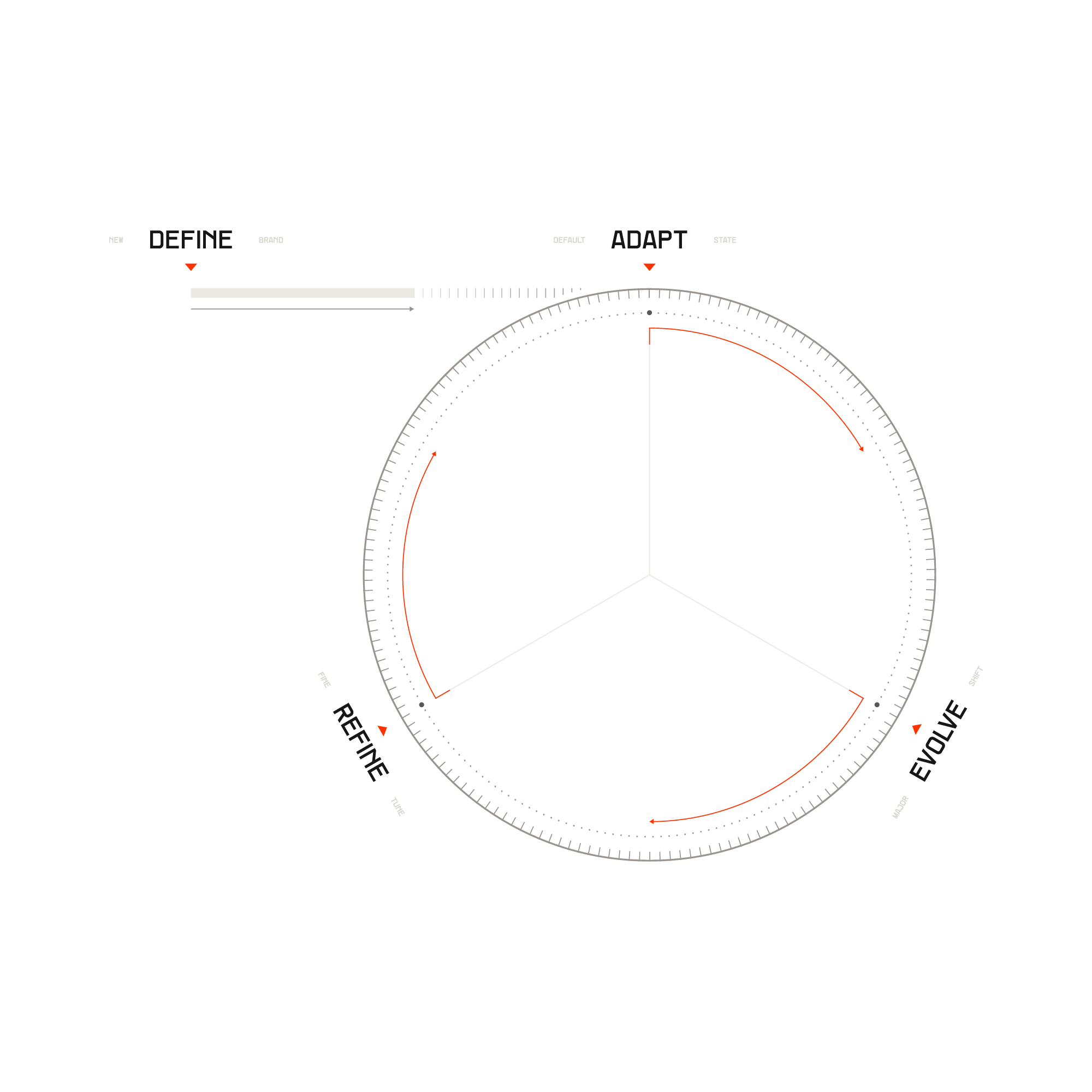
The point isn’t to turn your brand into a maintenance project that saps time and resources; it’s actually the opposite. The thinking around a brand needs to change from this fragile “thing” that needs protecting. Instead, we need to think of it as an integral part of the company, and a living “thing”.
You can run a rough drift check today, in about ten minutes, without any tools. Ask yourself five questions:
You can think of every hesitation as a data point; put them together and a pattern begins to form - that’s brand drift presenting itself.
If you want something more structured than a gut check, we’ve created a free tool that turns these instincts into a score you can act on. We also offer a Brand Diagnostic Session (£999) that goes deeper into where your brand has separated from your business and what to do about it. Both start from the same premise: you can’t fix drift you can’t see.
Drift isn’t a sign you did something wrong. It’s a sign your company is growing, and growth pulls the brand away from wherever it started - which is inevitable. What’s not inevitable is the rebuild every few years; that’s a choice, and one that’s made much earlier than most founders realise.
If you build a brand to be finished, you’ll be right back at the start a few years later. Build it to evolve, and the brand grows alongside the company, instead of being left behind by it.
Brand drift is the gap between what your brand says and what your company has become; it’s a problem of fit, not age, so a visual refresh won’t fix it.
Drift is a structural, not a discipline, failure: it’s what happens when a brand built as a fixed “thing” is asked to serve a company that never stops changing.
A brand built as a living system- which is scalable, modular and evolution-ready - adapts through growth instead of being broken by it. This ultimately makes the every-few-years rebrand cycle avoidable.
Want to know if your brand has drifted?
Take our free brand drift quiz